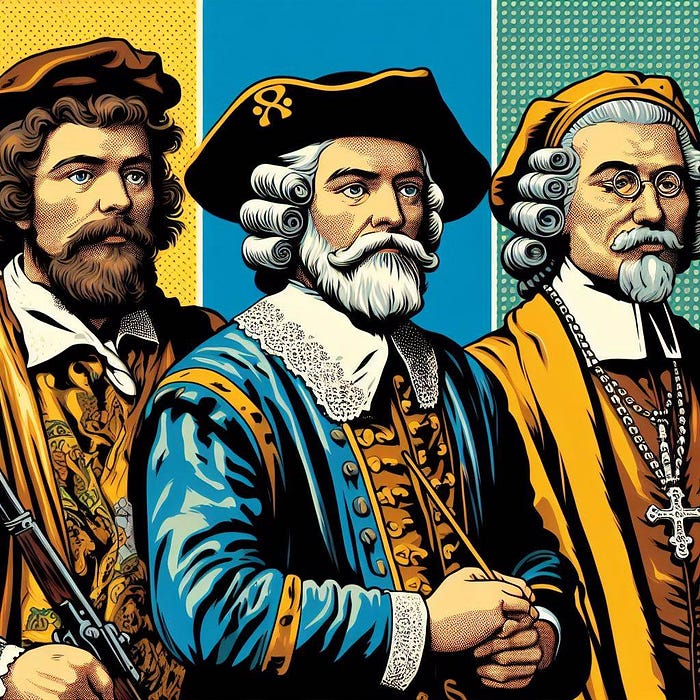
The idea of a political “left” and “right” dates back to France in the late 18th century.
It was an explosive time. It was the very end of the Ancien Régime in France and the Revolution was right around the corner.
Society was divided into three distinct estates:
- The First Estate was the clergy, who ran both the Catholic church and some portions of government.
- The Second Estate was the French nobility, except for the King. These folks had special privileges in society, particularly in relation to taxes.
- The Third Estate was everyone else, including peasants and wealthier merchants.
As you might imagine, the three estates had significant disagreements. A particular flashpoint was the rights and privileges of of the monarchy.
With the political situation growing tense, King Louis XVI summoned an assembly of all three estates to the Palace of Versailles. The gathered representatives would have the power to decide the future direction of the country.
The opening of the “Estates General” was May 5, 1789. Representing the three estates and coming from all over France, around 1,200 deputies arrived. The Estates General had not been called to meet since 1614.

The deputies were going to discuss matters central to French politics and society, with taxation and aristocratic privilege being at the forefront.
But where to sit?
The deputies sat in groups with others who generally felt the same as they did. Then, as now, humans naturally congregated in groups with other humans that largely viewed the world the same way as themselves.
The dividing line was the chair of the presiding member’s chair.
Those who were in favor of the current hierarchical structure with privileges for the monarchy say to the right of the chair. They were the traditionalists, the people who wanted to preserve the current order.
Those in favor of a new form of government with more representation for the Third Estate sat to the left of the chair. They wanted a more “fair” and egalitarian system. They wanted change.
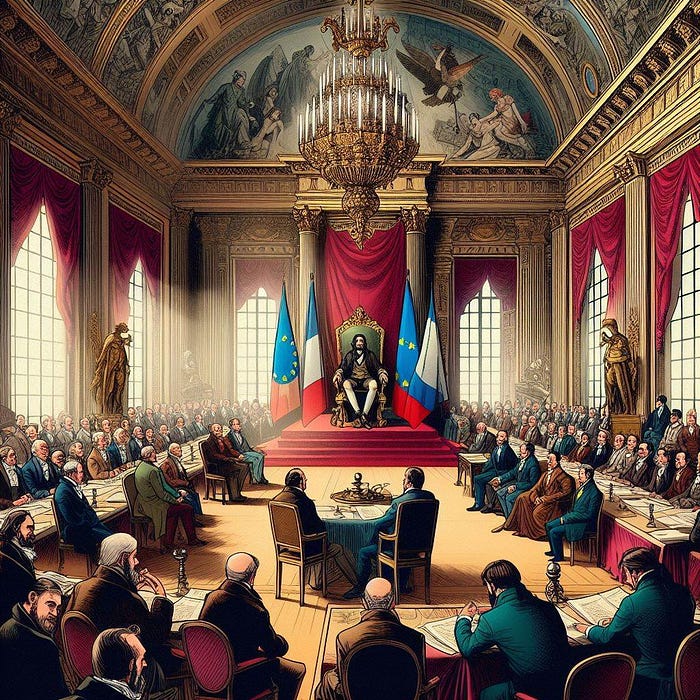
The term for the political “left” dates to this very moment. The physical position in a room relative to a chair.
That seat choice declared what values each representative held most dearly: order and tradition or egalitarianism and change.
The Primary Values of the Left
For those with a deep concern for the disadvantaged and who yearn for social equality and egalitarianism above all, the left side of the General Assembly was a good place to sit. Just like today, left leaning people may be most energized by reducing or abolishing inequalities they view as deeply unjust.
They may identify with the have-nots and may feel deep compassion and mercy for them.
These people may share a common vision for human society.
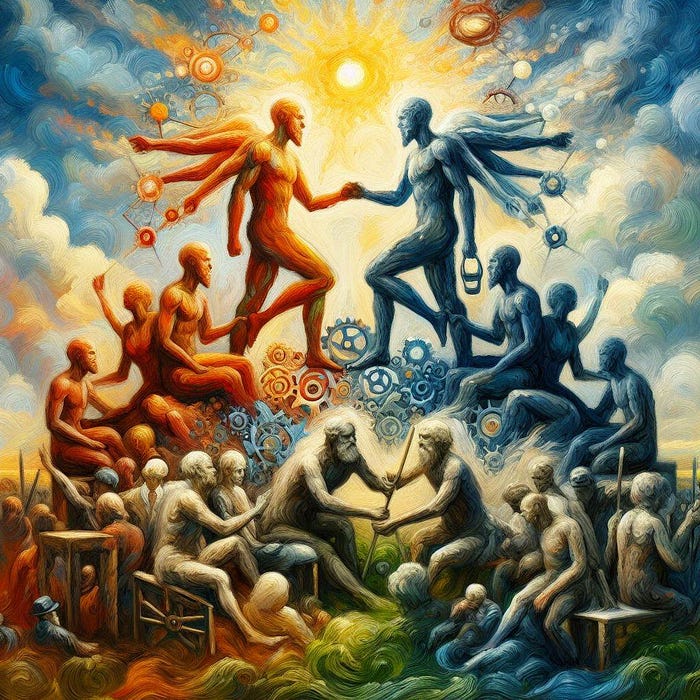
According to emeritus professor of economics Barry Clark, supporters of left-wing politics “…claim that human development flourishes when individuals engage in cooperative, mutually respectful relations that can thrive only when excessive differences in status, power, and wealth are eliminated.”[source]
Here is what that vision might look like if it were an impressionistic painting. At least, this is what AI thinks.
What about those on the right side of the room at the Estates General?
The Primary Values of the Right
For those who yearn for order and structure and tradition, sitting on the right seems like the place to be.
Back in 1789, these were the people who were in favor of privileges for the monarchy. France, after all, had been a monarchy for nearly 1000 years. France had been founded as a monarchy. France had always had a king and that king had always had great privileges. In some ways, the greatness of the king was the greatness of France.
[The French tradition dated back to West Francia in the year 843, when the territory was divided into 9 large geographical regions under Charles the Bald (Charles II). France was first called “France” after 987, and took its name from one of those regions.]
And you know, things seemed to be working out well for France. It became the most powerful and most prosperous country in Europe in the early 18th century. So this monarchy thing couldn’t be that bad, right? It was tough to make that claim based on the historical record.
While most of the political right doesn’t live in a monarchy today, right-leaning folks today are still not necessarily uncomfortable with structure and hierarchy.
Right-wing politics is the range of political ideologies that view certain social orders and hierarchies as inevitable, natural, normal, or desirable. Source
A supporter of right-wing politics would tend to see that human beings need structure in order to flourish.
What does a well functioning society based on laws and structure look like? Here’s one view based on what AI thinks the quote above might look like visually.
As you can see, DALL-E brings a distinctly U.S. flair with the Capitol in the background and flag-carrying cowboys in the foreground.

There’s even seals and crests that look like sheriff badges in the image.
DALL-E visualizes how supporters of right-wing politics tend to view rules and regulations as desirable. As necessary for a functioning society.
And they may seek to promote a society where those who break the law are punished. They see anarchy and disorder as dangerous and counterproductive to human flourishing.
Which Values Are “Better”?
This is what we all fight about, isn’t it? Although we might not think about it this way, of course.
We think in terms of the moral justification of our own positions and easily see the hypocrisy and the stupidity of the “other” side.
We gloss over the contradictions and failings of our own political side.
Because deep down, we all believe that our own values are the ones that really matter most. The ones that the world really needs more of in order to stop destroying itself.
We think that if we are in the right, those who see things differently must necessarily be wrong.
But what if that’s not true? What is multiple things can actually be true at once?
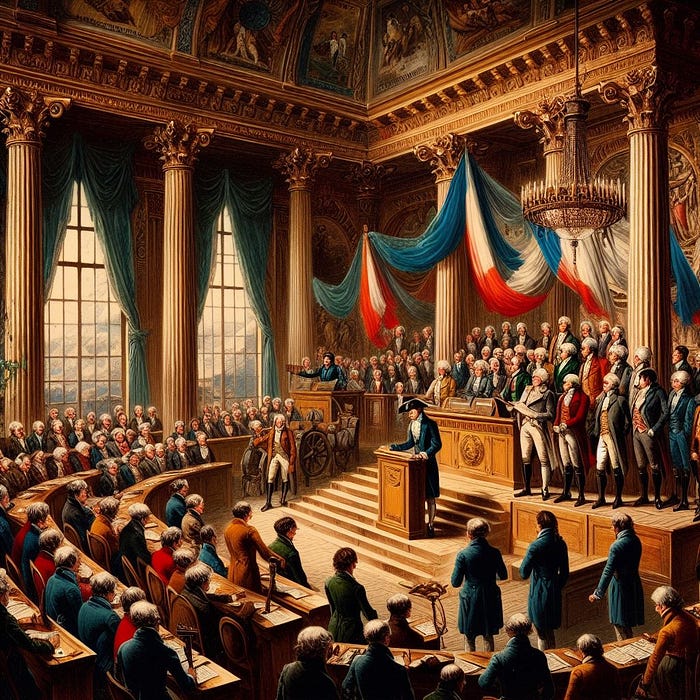
After all, it’s not hard to imagine what the left and right side of the room might have had to say if they got a chance to address the entire assembly of the Estates General.
Someone from the left side of the room might have said something like this.
You right-siders are seeking to preserve a system that works for your benefit. You have the power to levy taxes and you freely use it on others while excluding yourselves from the same burden. You represent a minority of the population and yet you own far more than an average amount of property and resources. You try to leverage your religion to get everyone to do what you want, and don’t see that you aren’t practicing what you preach. We need to change things!
– Hypothetical left side sitter, Estates General. 1789
Whoever said that (or something like it) would not have been wrong.
And those on the right might have said something like this.
You people on the left side of the room don’t understand the complexity of the situation. France has come through a trying period of war (the Anglo-French War 1778–1783), and we need some stability. We need to restore the country to fiscal strength. It’s true that there may be some excesses we can correct, but we’ve had the monarchy for hundreds of years and need to respect our tradition. Our system might not be perfect, but the alternative is chaos for everyone.
– Hypothetical right side sitter, Estates General. 1789

I’m not sure if I can spot the lie there, either.
And in fact, the upcoming Reign of Terror and the menace of the guillotine would have soon proven this right-sider to be correct.
Can both truly be correct at the same time?
This is Hard
It’s much easier for me to always imagine myself holding the moral high ground as I champion whatever the “most important” value is in a certain situation. It’s much harder to imagine that other people are made differently than me and may feel just as justified in their own perspective.
But what if there are multiple ways to esteem and value whatever is true, whatever is noble, whatever is right, whatever is pure, whatever is lovely, whatever is admirable?
What if we actually need both sides?
What if we actually need people who will constantly advocate for the disadvantaged and work to improve things for them? And what if we also need people who are deeply motivated by a desire for structures and good laws and enforcement of those laws?
What if some of us are always going to be wired to respond most strongly to whatever side feels more like “fairness” and “mercy” and some of us are always going to have an initial reaction to support “righteousness” and “order.”
It sounds impossible, especially if I stick with only whatever news source makes me feel most at home.

But maybe, it’s also the only way we can truly live here together. Maybe, the path forwards is to find a way to draw closer together rather than retreating towards whatever side feels like the most natural fit.
La vie est belle!

 How Should Christians Vote
Leave a comment