
Politics are complicated today.
But politics in the time of Jesus were far more complex.
Judea had become a Roman province in 6 AD (and stayed one until 132 AD). And there were — at least — 5 significant groups with some strongly different political feelings about what was best for society.
Here’s a quick summary of the major party position of each as it relates to the central political flashpoint of the day: what should the Jews do about the occupying Roman Empire?
- Pharisees: We can work as Jews to preserve and establish our own religious traditions in the midst of the unwelcome Roman influence
- Sadducees: We can partner with the Romans to maintain our religious and social status
- Herodians: We can partner with the Romans to maintain our political dynasty
- Essenes: We should completely withdraw from the polluting Roman influence and go live in the desert to pursue religious and moral purity
- Zealots: We should kill the Romans and take back Judea for the Jews
Let’s look at each in more detail, beginning with the Pharisees.
The Pharisees
The Pharisees often get a bad rap these days, but these were respected leaders of religious discipline and morality in first century Judea.
The Pharisees came from all classes of society, but were generally not the wealthy elites. They wanted to be pure for God and stayed away from non-Jews (Gentiles) to avoid becoming ritually unclean.

The word “Pharisee” comes from the Hebrew “parush” which means “one who is separated.”
Here are some Pharisee highlights.
Known for
- Following moral laws to the letter. Seeking to follow God.
Thoughts on Rome
- The Pharisees were no fans of Rome but recognized the political reality of Roman rule. They were willing to abide by Roman rule (pay taxes, etc) as long as did not conflict with their religious practices and following the Laws.
- If it were possible to live in Judea without Rome, the Pharisees surely would have been in favor of such an arrangement. But they were realistic about the political situation.
Legacy of the Pharisees
- The Pharisees made the synagogue an important part of Jewish life. Synagogues were not only places of religious worship but centers of social activity and education. It’s possible that there were hundreds throughout Judea at this time.
What did they view as central to religion?
- Following all of the moral laws (Mosaic written laws) and also judiciously following the traditions of the elders that had been passed down over time.
- They believed humans would be resurrected in life after death.
Some Pharisees in the Bible
- Nicodemus, who met with Jesus at night when he (Jesus) said that men must be “born again.” [John 3: 1–21]
- Joseph of Arimathea, who secured permission from Pilate to get the body of Jesus after his crucifixion, and buried him in a grave. [John 19: 38–42]
- The Apostle Paul (also called Saul), who encountered Jesus after his death and went on to spread the news of Jesus throughout the empire and to write more than half of the books of the New Testament. [Acts 23:6]
What Did the Pharisees Think About Jesus?
- Outside of the three mentioned above, the Pharisees and Jesus didn’t exactly see eye to eye. Jesus is recorded as calling out their hypocrisy for looking good on the outside but not being changed by God’s love on the inside. Until his conversion, Paul persecuted followers of Jesus and approved of the death by stoning of the first Christian martyr. [Acts 8: 1–3]
Party Platform
- The party of the common man who believes in God and wants to do good. The moral majority in early first century Judea.
Summary
- The Jewish “good guys” who had a real problem with Jesus. Not that Jesus exactly made it easy on them. In Mathew 23, Jesus calls them “hypocrites” six times for focusing on outward displays of morality over inward heart change, not to mention naming them as “snakes” and a “brood of vipers.”
The Sadducees
The ruling class of priests, aristocratic families, and wealthy elites who were responsible for the Temple in Jerusalem. The word Sadducee means “High Priest” (Tsdoki) in Hebrew.

What Were the Sadducees Known For
- Unlike the Pharisees, the Sadducees did not follow the oral law. Instead, they accepted only the written law, the first 5 books of the Old Testament (also called Torah or the Law or known as the Pentateuch in Christianity).
- They also disagreed with the Pharisees when it came to belief in the afterlife. They did not believe in an immortal human soul.
- Temple worship was central for the Sadducees. The temple in Jerusalem was the focus of the Jewish faith and also a major source of economic activity. The Sadducees oversaw the daily operations of the Temple, including rituals and animal sacrifice.
Thoughts on Rome
- The Sadducees had political influence coming from a tenuous alliance with Rome. They also had dealings with the client King who ruled in Rome.
- The High Priest was a Sadducee who ruled at the pleasure of Rome and was allowed to directly influence day to day life for Jews provided that he didn’t run afoul of Rome.
Legacy of the Sadducees
- Following the destruction of the Temple in 70 AD by the Romans, the Sadducees were no longer mentioned in history.
What did they view as central to religion?
- They saw the rituals and sacrifices of the Temple as the central element to following God.
Sadducees in the Bible:
- Caiphas, the High Priest who presided over the Jewish trial of Jesus, was a Sadducee.
- The Sadducees interact with Jesus a few times, including in Mathew 22:23–33 where they try to test Jesus about his views on life after death.
What Did the Sadducees Think About Jesus
- The Sadducees were not huge fans of Jesus. He threatened the delicate political balance with Rome that was essential for the Sadducees to maintain political power.
- They worked in conjunction with the Pharisees on a Jewish council called the Sanhedrin and met to come up with a plan for dealing with Jesus. The Sanhedrin — from the Greek synedrion, meaning “sitting together”— was led by Caiphas, the high priest. John 11 47–50 (NIV) records their meeting about Jesus and the political determination made by Caiphas, who presided over the Sanhedrin as high priest.
47 Then the chief priests and the Pharisees called a meeting of the Sanhedrin. “What are we accomplishing?” they asked. “Here is this man performing many signs. 48 If we let him go on like this, everyone will believe in him, and then the Romans will come and take away both our temple and our nation.” 49 Then one of them, named Caiaphas, who was high priest that year, spoke up, “You know nothing at all! 50 You do not realize that it is better for you that one man die for the people than that the whole nation perish.”
John 11: 47-50
Party Platform
- The party of ritual and tradition. If we follow these laws that God laid down for us, life should go well for us. If that means working with Rome in order to preserve order and the existing social structure, then so be it.
The Herodians
Supporters of the Herodian dynasty, while ruled over Judea as a client government under Rome.

What Were the Herodians Known For
- The Herodians were the ruling aristocracy in Judea at the time of Jesus. They followed the Hasmonean dynasty and their first King, Herod the Great, was appointed by Rome in 37 BC. The dynasty lasted until 73 AD, when the Great Jewish Revolt had been put down by Rome.
- The Herodians had common interests with the Sadducees as both groups were in favor of maintaining the status quo and preserving their political influence.
- Herod Antipas sat on the throne during the time of Jesus. He was the son of Herod the Great — the Herod who is identified in Mathew 2:16–18 for ordering the execution of infants 2 years and under in the vicinity of Bethlehem, in an attempt to kill the baby Jesus.
Thoughts on Rome
- The Herodians had a favorable attitude toward Rome and actively collaborated with the Empire. The Herodians supported Herod Antipas which, by extension, meant support of Rome. Herodians acted as intermediaries between Roman power and the Jewish populace.
- The Herodians were pragmatic in their approach to governance and were opposed to any individual or group that could destabilize the social order.
Legacy of the Herodians
- Herod Agrippa II (sometimes called Agrippa) was the last ruler of the Herodians. He was the cousin of Herod Antipas. Agrippa took the side of Rome during the Great Jewish Revolt that began in 66 AD and ultimately died without any children at age 70 in the year 100 AD.
What did they view as central to religion?
- The Herodians were generally less focused on religious matters than on dealing with political realities. With that said, their religious practices would likely have lined up most closely with the Temple worship practices of their allies, the Sadducees.
Herodians in the Bible
- In Mark 12: 13 -17, the Herodians seek to trap Jesus by asking him about his own politics as it relates to paying taxes to Rome.
- Before his execution, Jesus is brought before Herod Antipas [Luke 23:6–12] before being sent back to Pontius Pilate.
- The Apostle Paul meets with Herod Agrippa II and tells Agrippa his full conversion story in Acts 26 when he is accused by the Jews for his beliefs about Jesus. Paul appeals to Caesar and is ultimately sent to Rome where he is eventually killed.
What Did the Herodians Think About Jesus?
- We can assume the Herodians were generally negative towards Jesus. Like the Sadducees, the Herodians were in favor of the existing social order and opposed to anything that might disrupt the political balance. With his claim to be a king with a new kingdom not of this world [John 18:36], Jesus threatened that.
Party Platform
- The party of the aristocracy and social elites. We must work with Rome and preserve the existing social structure for the good of the people.
The Essenes
The Essenes were a distinct sect within Judaism that existed from the second century BC to the first century AD. They withdrew from mainstream society and lived in their own communities. They lived disciplined and communal lives and were the closest corollaries to the Christian monastics that emerged in the 3rd century.

What Were the Essenes Known For?
- The Essenes lived in desert communities that were likely physically separated from the rest of Jewish life.
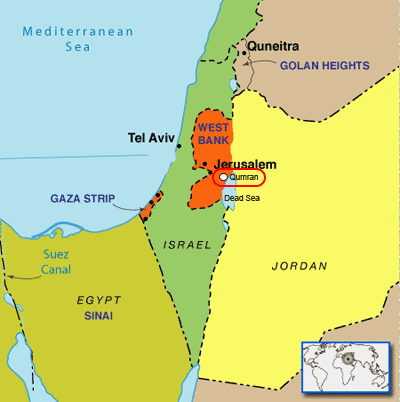
- The Essenes are connected with the Dead Sea Scrolls, which were found at Qumran (picture below). They lived ascetic lives with minimal creature comforts.

Thoughts on Rome
- Some scholars believe the Essenes originated from the high priestly class during the Hellenistic age. That was the time between the death of Alexander the Great and the Roman Empire. Rather than live under foreign influence, they chose to withdraw to the desert and separate themselves to live more pious lives.
- Their exact origin is unknown, but whether they had ancient ties with the Sadducees or not, the Essenes certainly had quite different thoughts on Rome. Rome, and any outside cultural influence, would have been seen as a corrupting force that the Essenes were withdrawing from.
The Essenes considered themselves the remnant of Israel, God’s “eternal plantation” whose preparations would bear fruit in the coming of the Messiah
[Source, JSTOR, Essenes]
Legacy of the Essenes
- Scholars connect the Essenes with the Dead Sea Scrolls, which were discovered in the West Bank over a period of 10 years between 1946 and 1956. The scrolls date from the 3rd century BC to the 1st century AD which is when the Essenes lived. And they were discovered in the caves at Qumran.
- At over 2,000 years old, the Dead Sea Scrolls are the oldest surviving manuscripts of many of the books of the Bible. All but one of the books in the Hebrew Bible (the Old Testament of the Christian Bible) are represented in the scrolls, which were discovered hidden in 11 different caves.
What did they view as central to religion?
- The Essenes shared some important similarities with the Pharisees. Like the Pharisees, they strictly followed the Jewish Law, including dietary laws and ritual purity practices.
- The Essenes also had firm beliefs in the coming of the Messiah, who they believed would establish God’s kingdom on earth. This was their hope for the future.
Essenes in the Bible
- The Essenes are not mentioned in the Bible. However, some scholars speculate that John the Baptist, who preached throughout Judea about the coming of the Messiah, was an Essene. Both John the Baptist and the Essenes emphasized the need for personal repentance and water baptism for spiritual renewal.
What Did the Essenes Think About Jesus?
- We don’t know if John the Baptist was an Essene, but there is certainly an overlap between the Messianic expectations of the Essenes and the work of John the Baptist. And after John had been imprisoned by Herod Antipas, Jesus told the crowds following him that there was no greater prophet than John.
7 As they went away, Jesus began to speak to the crowds concerning John: “What did you go out into the wilderness to see? A reed shaken by the wind? 8 What then did you go out to see? A man dressed in soft clothing? Behold, those who wear soft clothing are in kings’ houses. 9 What then did you go out to see? A prophet? Yes, I tell you, and more than a prophet. 10 This is he of whom it is written, “‘Behold, I send my messenger before your face, who will prepare your way before you.’ 11 Truly, I say to you, among those born of women there has arisen no one greater than John the Baptist. Yet the one who is least in the kingdom of heaven is greater than he.
[Source, Mathew 11: 7–11]
Party Platform
- The Essenes placed none of their hopes in human politics. They were focused on the supernatural and future kingdom of God. If it came to voting today, they might be the ones who conscientiously objected and prayed that God would come and redeem the world and those faithful to Him.
The Zealots
The Zealots had fierce objections to Roman rule and were not afraid to fight and die for their commitment to liberty.
From the Hebrew word kanai the name means “one who is zealous on behalf of God.”

What Were the Zealots Known For?
- The Zealots were a political movement that advocated for the Jews to rise up and expel the occupying Romans. As such, they were generally opposed to Sadducees and Herodians who were willing to collaborate with Rome.
- In terms of their religious convictions, they were quite similar to the Pharisees. But their commitment to liberty did not allow them to peacefully coexist. Here is how the Jewish Roman historian Josephus described the Zealots:
These men agree in all other things with the Pharisaic notions; but they have an inviolable attachment to liberty, and say that God is to be their only Ruler and Lord. They also do not value dying any kinds of death, nor indeed do they heed the deaths of their relations and friends, nor can any such fear make them call any man lord.
[Source, Josephus, Antiquities of the Jews, Book 18)
Thoughts on Rome
- A good Roman is a dead Roman.
- The Zealots believed only God had sovereignty over Israel and rejected any kind of foreign authority. Their objections were on both religious and nationalist grounds. There was no room for compromise.
Legacy of the Zealots
- The Zealots were leading figures in the First Jewish-Roman War in 66–73 AD. Also called the Great Jewish Revolt, this was the first of three major rebellions of the Jews against Rome. The Herodian King Agrippa II and Roman officials were forced to flee Jerusalem and leading Emperor Nero to send Vespasian with four legions to put down the rebellion. Vespasian moved into Galilee in 67 AD. Vespasian ultimately left his son Titus in charge of the campaign, which ended with a 7 month siege of Jerusalem and the destruction of the Temple. Josephus wrote that over 1 million people died during the siege.
- Despite the devastation at Jerusalem, the Zealots kept fighting after the Temple had been destroyed. One of the final battles was at the hilltop fortress of Masada, where the Zealot defenders all chose to kill themselves rather than surrender to the Romans.
What did they view as central to religion?
- The Zealots believed in strict adherence to religious laws and believed that the land of Israel had been giving to them by divine mandate. These beliefs went hand in hand.
Zealots in the Bible
- One of the disciples of Jesus was a Zealot. This is how the Gospel of Luke records Jesus calling his disciples. Simon the Zealot also appears in Mark, Mathew, and the book of Acts.
12 In these days he went out to the mountain to pray, and all night he continued in prayer to God. 13 And when day came, he called his disciples and chose from them twelve, whom he named apostles: 14 Simon, whom he named Peter, and Andrew his brother, and James and John, and Philip, and Bartholomew, 15 and Matthew, and Thomas, and James the son of Alphaeus, and Simon who was called the Zealot, 16 and Judas the son of James, and Judas Iscariot, who became a traitor.
[Source: Luke 6:12–16]
What Did the Zealots Think About Jesus?
- Outside of Simon the Zealot, we don’t have much evidence for what the Zealots thought about Jesus. But it seems likely they would have had major philosophical disagreements with his calls to love one’s enemies and to place hope in a kingdom not of this world.
Party Platform
- We must retake Israel for the Jews.
So What?
It’s pretty easy to get worked up about politics. To believe that what we believe is objectively right and true and properly considers the issues in the priority they intrinsically deserve.
Jews in first century Roman Judea certainly had strong political convictions. The Pharisees wanted to exist in society but as a people set apart, to show their devotion to God. The Essenes were willing to withdraw completely to live in the desert for them. The Zealots were willing to kill for them. The Sadducees and Herodians were willing to collaborate with a foreign power.
They all believed them intensely. And they all believed things that were right.
Even the Sadducees and the Herodians, who might seem like the least defensible groups, were correct about things. They believed it was an absolute political necessity to collaborate with Rome and that that resistance was unthinkable. The result of the Jewish Roman Wars and the destruction of the Temple would seem to vindicate them.
But did that make them all equally right? Clearly no, although a postmodern worldview might suggest otherwise.
I can see myself in all of these political groups. And it’s only in Jesus that there is real truth.
It’s only Jesus who can gently call out the hypocrisy of my inner Pharisee.
Who can look at the Sadducee in me and lead me to a faith that moves beyond ritual.
Who can tell the Herodian inside that true power does not lie in this world.
Who can tell my inner Essene that as much as I may want to withdraw sometimes, to instead ask if He’s calling me to move out into the world.
And to tell my Zealot side that it is good to fight, but to remind me who we are fighting against.
For we do not wrestle against flesh and blood, but against the rulers, against the authorities, against the cosmic powers over this present darkness, against the spiritual forces of evil in the heavenly places.
[Source, Ephesians 6:12]

 How Should Christians Vote
Leave a comment